
The Mechanics of Causal Intelligence: Geometrizing Thick and Thin Data
Traditional business intelligence platforms suffer from a systemic “insights lag,” relying on decontextualized quantitative metrics that explain what is happening but fail to explain why. To resolve this, Catalyzer.us generates a proprietary, context-aware database by integrating two structurally distinct yet complementary datasets, redefined through our collaborative work with Ipvive.com:
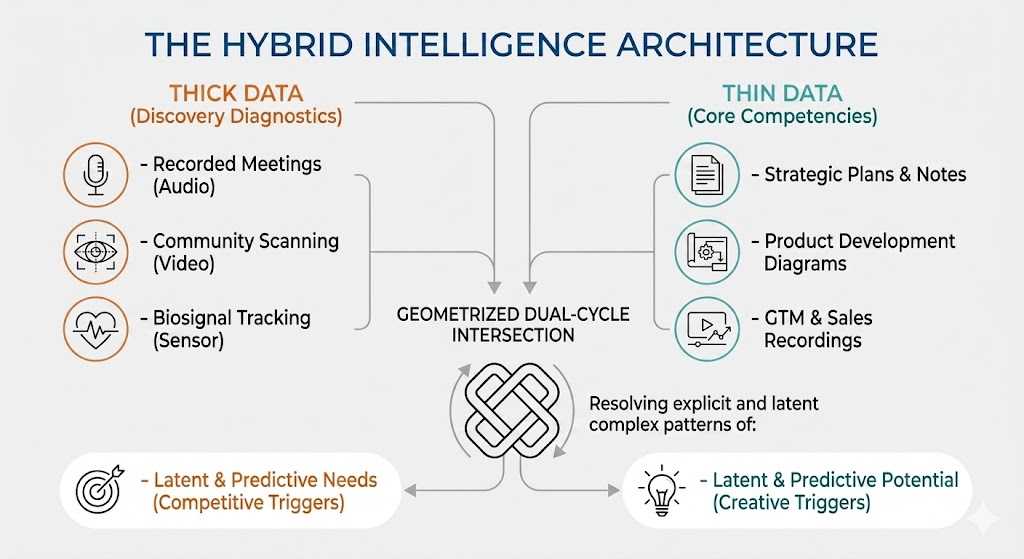
1. Thin Data (Daily Core Competencies & Products/Services)
Thin data represents the precise, discovered, and unmodeled inputs of daily organizational activity and operational mechanics. It maps the “what” of enterprise operations and includes:
- Strategic plan and notes: Codified long-horizon and transactional objectives.
- Product development and notes/diagrams: High-fidelity technical layouts, architectural concepts, and engineering specifications.
- Market development plan and notes: Target segments, regional distribution channels, and GTM milestones.
- Sales interactions and notes/recordings: Granular B2B client dialogues, negotiation touchpoints, and CRM pipeline events.
- Global competitive forces: International supply chain agility, macro-economic shifts, and competitive cross-border trade indicators.
2. Thick Data (Discovery Diagnostics & Ordinary Behavior Digital Records)
In contrast to quantitative process logs, thick data serves as our comprehensive background context, capturing natural human interactions and physiological baselines.3 We enrich traditional qualitative research by capturing ordinary behavior digital records passively and continuously as a side effect of daily operations:
- Set consumer or business recorded meetings daily (audio): Natural, multi-stakeholder dialogues, capturing linguistic patterns, cognitive focus shifts, and explicit/implicit objections.
Local community scanning (video): Spatiotemporal visual records of regional logistics, community mobility, and localized drayage flow. - Random local community interactions (audio): Real-time, informal conversations and qualitative exceptions captured in natural environments.
- Sensor as a Service explorer biosignals (+emotion/thinking) during interactions: Non-invasive monitoring of physiological fatigue markers, heart rate variability (HRV), and electrodermal stress indicators to index real-time emotional and cognitive load during live commercial transactions.
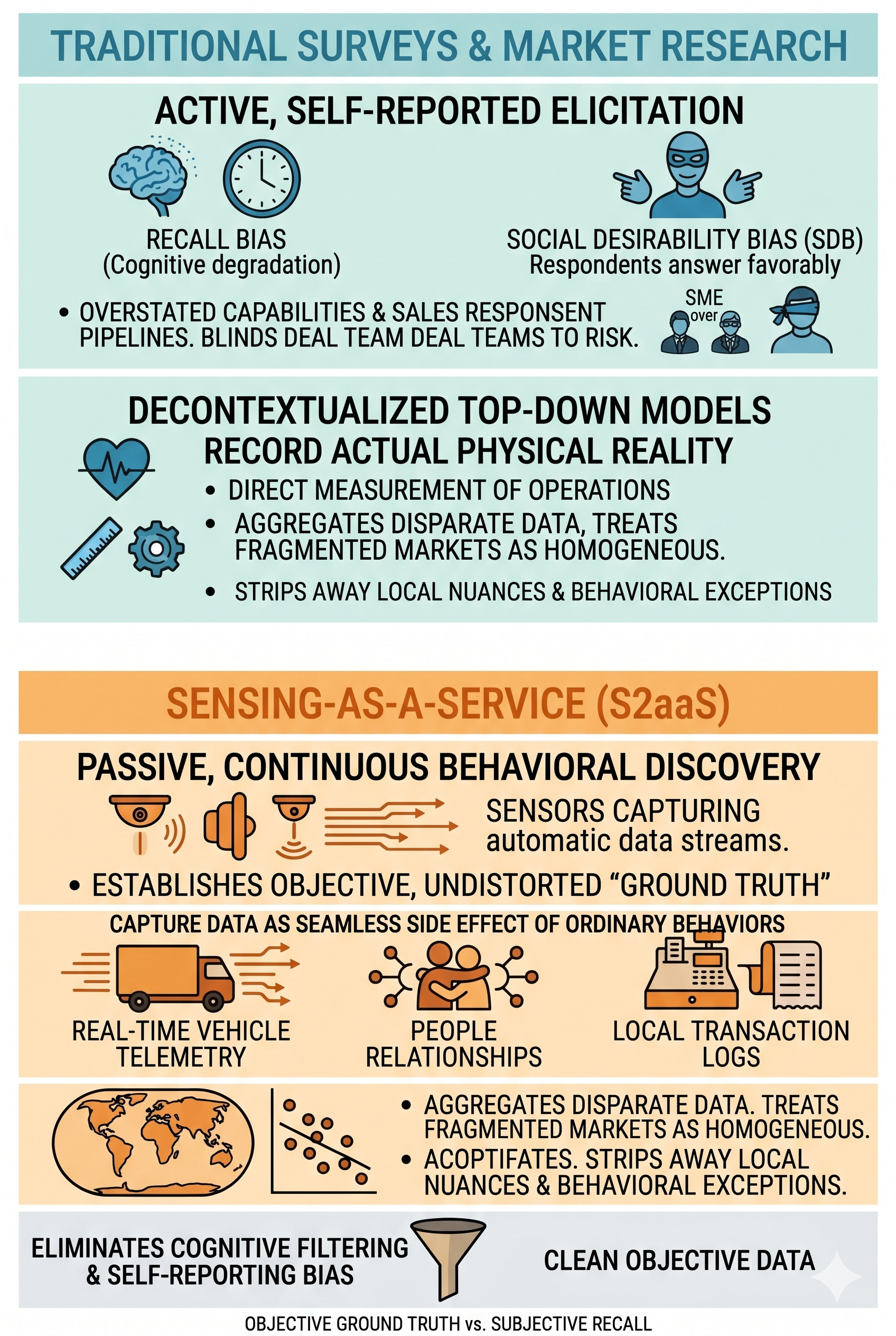
Why & How: Sensing-as-a-Service vs. Traditional Surveys
Traditional B2B market research depends on self-reported surveys and focus groups, which are inherently flawed. Human memory is notoriously fallible and prone to systemic recall bias (the cognitive degradation of memories over time). Furthermore, self-reports are severely compromised by social desirability bias (SDB)—the conscious or unconscious tendency of respondents to answer questions in a manner that will be viewed favorably by others. In commercial due diligence, this SDB-driven “perception gap” consistently leads small-to-medium enterprise (SME) executives to overstate their sales pipelines, GTM capabilities, and technological readiness, blinding deal teams to post-close risk.
Top-down econometric modeling similarly fails due to decontextualization. By aggregating disparate transactional data and discarding “outliers” to fit a standardized average, traditional models treat highly fragmented regional markets as homogeneous systems. This decontextualization strips away the local nuances, cultural trust structures, and behavioral exceptions that dictate actual GTM success, leading to high failure rates when scaling innovations.
Sensing-as-a-Service (S2aaS) bypasses these distortions by replacing active, self-reported elicitation with passive, continuous, and unmodeled behavioral discovery.3 By capturing data as a seamless, unmodeled side effect of ordinary behaviors—such as real-time vehicle telemetry, container logistics, and local transaction logs—we establish an objective, undistorted “ground truth” metric.

Physiological, spatial, and mechanical sensors record the actual physical reality of an operation, eliminating cognitive filtering and self-reporting bias.

Thurston Geometrization and Homotopy: The Mathematics of Manifold Alignment
To resolve the data noise objection—the criticism that an abundance of unmodeled sensor data can degenerate into chaotic noise—the Catalyzer platform employs a highly rigorous, mathematical “glass box” engine developed in partnership with Ipvive.com.
We project our fast-cycle Blum Conscious Turing Machine (CTM-AI)—which ingests real-time LiDAR (via LiDAR-LLM and B4DL), RGB posturing (via LiCamPose), and audio on our Microsoft Surface RTX Spark Dev Box edge-computing nodes—onto a finite-dimensional covariate subspace, constructing a computable, invertible Fisher Information matrix. This topological framework is built upon William Thurston’s Geometrization Conjecture and Homotopy Equivalence:
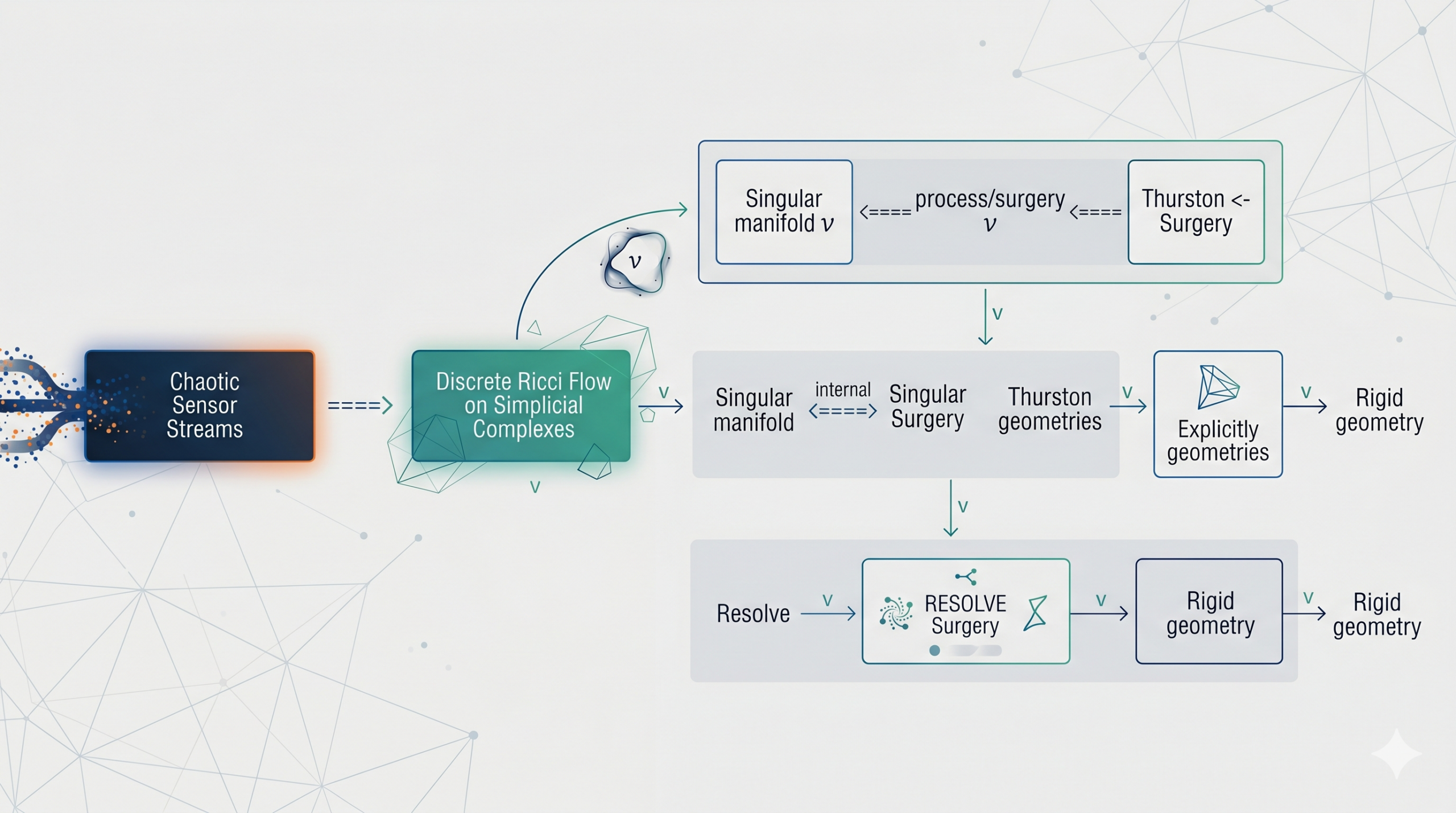
By running discrete surface Ricci flow on triangulated simplicial complexes, we deform raw, chaotic sensor streams proportionally to the Gaussian curvature, resolving singular pinch points and deforming the state space into stable, locally homogeneous Thurston geometries:

Where is the conformal factor, is the Gaussian curvature at vertex, and is the target curvature.
Our framework operates on the premise of Mostow Rigidity: any homotopy equivalence between three-dimensional hyperbolic manifolds can be uniquely deformed to a global isometry. This establishes that “geometry equals topology”, transforming unstructured local observations into mathematically rigid, highly predictive manifolds.
This structural memory enables Personalized Lensing. By pulling back the Riemannian metric across our discrete conformal maps, we construct a customized, non-distorting geometric “lens” to calculate and autocorrect real-time Drift Factors under extreme environmental noise. This personalized validation service drives real-time GTM autocorrective loops, accelerated B2B character development, and zero-trust resource management.
Discover how this methodology is operationalized on our Strategic Sprints.
CATALYZER.US
Architecting Society 6.0: Creative Capital is the Advantage, Relationship Capital is the Scaler.
Hubs
- Silicon Valley, USA: Berkeley, CA + all 50 States.
- Japan: All 47 Prefectures.
- Indonesia: All accessible Communities.